FINAL PART
“Sweetheart,
you don’t have to,”
I said, standing up.
But Oliver didn’t look at me.
He looked directly at his grandmother.
“Grandma, do you think I’m ugly?”
Patricia’s face changed instantly.
“Oh, Oliver, no! Of course not!”
“Then why do you always
talk about my tummy?”
Nobody moved.
Oliver continued, his voice trembling.
“At school, one boy called me fat.
I didn’t tell you because
I thought you would say
I was fat too.”
I felt tears gathering in my eyes.
David slowly stood up.
“Mom, do you understand
what you’ve done?”
Patricia reached for her napkin.
“I was only teasing him.
Children are sensitive these days.”
David shook his head.
“No.
Children remember
what adults say to them.
Especially when those adults
are supposed to love them.”
My sister-in-law looked down at her plate.
One of the cousins quietly moved
Oliver’s abandoned cake away from
the edge of the table.
Then Patricia said something
that made the situation even worse.
“Well, perhaps if everyone stopped
making such a big deal about his weight,
he wouldn’t be so sensitive about it.”
David stared at her.
“That’s enough.”
His voice wasn’t loud, but it was firm.
“Oliver’s body is not a topic for entertainment. Not tonight. Not ever.”
I took Oliver’s hand.
“Let’s go upstairs for a little while, sweetheart.”
As we walked away, I heard Patricia whisper:
“David, you’re making me look like a terrible grandmother in front of everyone.”
But David answered before I could turn around.
“Mom, you did that yourself.”
We spent the next twenty minutes in the guest bedroom.
Oliver sat on the bed, holding his favorite dinosaur toy.
Then he asked me a question I will never forget.
“Mommy, when the doctor calls, will he tell me I have to stop eating cake?”
I hugged him tightly.
“No, baby. The doctor is here to help us understand why your tummy hurts. You haven’t done anything wrong.”
He buried his face in my shoulder.
And then David walked into the room.
He had something important to tell us.
“Patricia wants to apologize,” he said.
I looked at him.
“Does she understand why?”
He hesitated.
“That’s what I told her we need to find out.”
But none of us knew that the next morning would bring a phone call that would change our family forever.
PART 3 – The Phone Call That Changed Everything
The next morning, Oliver woke up unusually quiet.
He didn’t ask for pancakes.
He didn’t ask to watch cartoons.
He simply sat at the breakfast table, moving his spoon around his bowl.
David noticed.
“Hey, buddy. Want to build that dinosaur puzzle after breakfast?”
Oliver shrugged.
“Maybe.”
Then my phone rang.
It was the pediatrician’s office.
My stomach tightened immediately.
“Hello?”
The nurse asked me to confirm Oliver’s date of birth.
Then she said the doctor wanted to speak with us about his test results.
I felt my hands go cold.
“Is something wrong?”
“Dr. Miller would prefer to explain everything directly. Can you come in this afternoon?”
I looked at David.
He immediately understood.
We arranged an appointment for later that day.
For the next few hours, my mind went through every possible scenario.
Was it something serious?
Was it related to his stomachaches?
Had we missed something?
Oliver noticed our expressions.
“Mommy, am I in trouble?”
I knelt beside him.
“Absolutely not. We’re just going to see the doctor, sweetheart.”
At the appointment, Dr. Miller greeted Oliver warmly.
He asked about school, dinosaurs, and his favorite soccer team before discussing the results.
The doctor explained that the tests showed signs of a digestive problem that needed further evaluation.
There was no reason to jump to frightening conclusions, but Oliver needed additional examinations and a treatment plan.
Then Dr. Miller turned toward us.
“I also want to discuss something important. Oliver is at an age where comments about his appearance can affect how he sees himself. Please make sure he understands that his weight doesn’t determine his worth.”
David nodded.
“We understand.”
The doctor continued.
“Focus on his comfort, his health, his sleep, his energy, and helping him enjoy being a child. Avoid making food or his body something he feels ashamed of.”
Oliver was listening.
He looked up and asked:
“Doctor, am I bad because my tummy is big?”
Dr. Miller immediately leaned closer.
“Not even a little bit, Oliver. Bodies come in different shapes and sizes. Your job is to play, learn, laugh, and grow. Our job is to help you feel better.”
Oliver finally smiled.
On the drive home, David was unusually quiet.
Then he said:
“I’m calling my mother.”
I knew exactly why.
That evening, Patricia arrived at our house.
She brought Oliver a dinosaur coloring book and a small box of chocolates.
But David didn’t let her avoid the conversation.
“Mom, before you give him anything, I need you to listen.”
Patricia sat down.
David explained what the doctor had said.
He told her that Oliver needed support, not comments about his appearance.
Patricia’s eyes became watery.
“I didn’t know it was hurting him that much.”
I answered gently.
“You knew he was struggling. You knew about the doctor’s appointment. But even if you hadn’t known, humiliating a child about his body isn’t harmless.”
Patricia looked at Oliver.
“Sweetheart, Grandma is sorry.”
Oliver held his dinosaur coloring book.
“Are you going to call me curvy again?”
Patricia shook her head.
“No, baby. I promise.”
Oliver considered her answer.
Then he asked:
“Can I still have chocolate cake at your next birthday?”
For the first time since the dinner, everyone laughed.
Patricia wiped her eyes.
“Of course you can.”
But David wasn’t finished.
He had one more boundary to establish.
“Mom, we love you. But if you ever make comments about Oliver’s body again, we’ll leave. And we won’t put him in a situation where he has to listen to that.”
Patricia nodded.
“I understand.”
I wanted to believe her.
But an apology is only the beginning.
The real test would be what happened next.
PART 4 – THE FULL ENDING: THE GRANDMOTHER FINALLY UNDERSTOOD
Three weeks passed.
Oliver continued seeing his doctor.
His stomachaches gradually became less frequent with the care plan they had started, although we still had follow-up appointments to attend.
We made a conscious decision at home.
We stopped talking about his body.
We talked about how much fun he had at soccer practice.
We celebrated when he learned a new dinosaur’s name.
We made Saturday pancake mornings a family tradition.
And most importantly, we made sure he understood that he never had to earn love by looking a certain way.
Patricia, meanwhile, became unusually quiet.
She didn’t call as often as she used to.
At first, I thought she was angry with David.
Then, one afternoon, she called me.
“Could I come over tomorrow? Just for a little while?”
I agreed.
The following afternoon, she arrived carrying an old photograph album.
Oliver was sitting on the living-room rug, building a dinosaur park.
Patricia sat beside him.
“Oliver, would you like to see some pictures of Daddy when he was little?”
Oliver immediately became interested.
“Did Daddy like dinosaurs?”
Patricia laughed.
“He loved them. But he also loved chocolate cake.”
She opened the album.
There were pictures of David at five, six, and seven years old.
In one photograph, he was standing beside a birthday cake, wearing a shirt that was clearly too small.
Oliver giggled.
“Daddy had a big tummy too!”
David, who had just walked into the room, raised his eyebrows.
“Excuse me. That was a perfectly normal dinosaur-loving tummy.”
Everyone laughed.
But Patricia became thoughtful.
She stared at the photograph for a moment.
Then she said something unexpected.
“When your daddy was little, people made comments about his appearance too.”
David sat down.
“Mom, what are you talking about?”
Patricia looked uncomfortable.
“Your grandmother used to make jokes about your weight. I thought it was normal. I thought teasing children made them stronger.”
David’s expression changed.
“Do you remember how it made me feel?”
Patricia nodded slowly.
“I remember you stopped wanting to eat at family gatherings.”
The room became quiet.
David looked at her.
“Exactly. And I promised myself I would never make my child feel that way.”
Patricia’s eyes filled with tears.
“I didn’t realize I was repeating the same thing.”
I finally understood something important.
Patricia hadn’t simply made one careless joke.
She had repeated a behavior she had grown up believing was acceptable.
That didn’t excuse what she had done.
But perhaps it explained why she had struggled to understand the damage.
She turned toward Oliver.
“Sweetheart, I want to tell you something.”
Oliver looked up from his dinosaur.
“You never have to hide your tummy from me. I was wrong to make jokes about it. You are a wonderful boy, and I love you exactly as you are.”
Oliver studied her face.
Then he asked:
“Even when I eat two pieces of cake?”
Patricia smiled through her tears.
“Even then.”
He thought about it.
“Okay. Can we play dinosaurs now?”
Patricia laughed.
“Absolutely.”
And that afternoon, she sat on the carpet and played dinosaurs with her grandson for nearly an hour.
No comments about his stomach.
No jokes about his appearance.
Just a grandmother and her grandson building a dinosaur world.
A month later, we attended another family gathering.
This time, it was a Sunday lunch at Patricia’s house.
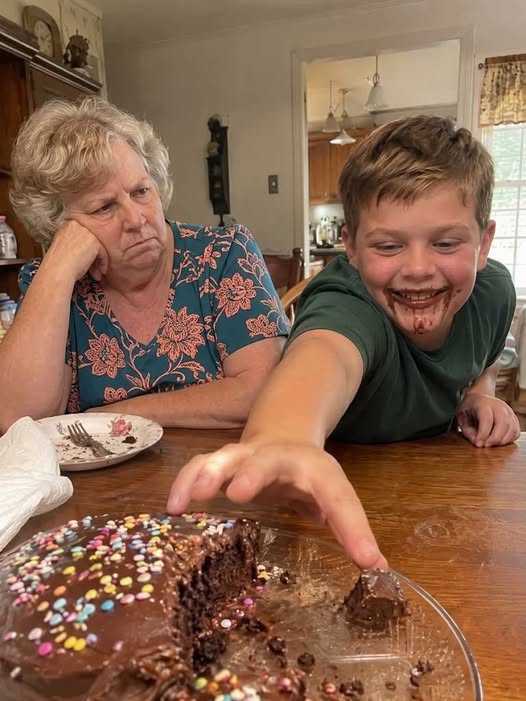
Oliver was excited because she had promised to make his favorite chocolate cake.
When dessert arrived, Oliver reached for a slice.
Patricia smiled.
“Would you like the bigger piece, sweetheart?”
Oliver nodded enthusiastically.
David glanced at me.
We both smiled.
Then one of the relatives joked:
“Careful, Oliver! That cake looks bigger than you!”
Before I could respond, Patricia spoke.
“Let’s not comment on his body or his food. He’s here to enjoy himself, just like everyone else.”
I looked at her in surprise.
She wasn’t trying to impress us.
She wasn’t performing an apology.
She simply understood.
Oliver continued eating his cake, completely unaware of the significance of that moment.
Later, while we were saying goodbye, Patricia pulled David aside.
“I want you to know something,” she said.
“I’ve been thinking about what you asked me that night.”
David looked at her.
“Which question?”
“Why I kept making jokes when I knew Oliver was already frightened about his health.”
She took a deep breath.
“I didn’t have a good answer. I thought I was being funny. I didn’t stop to think about the little boy sitting in front of me.”
David hugged her.
“That’s all I wanted you to understand.”
On the drive home, Oliver fell asleep in the back seat.
His dinosaur toy rested against his chest.
I looked at David.
“Thank you for standing up for him.”
He reached over and held my hand.
“He’s our son. He should never have to wonder whether his own family accepts him.”
I looked back at Oliver.
And I thought about that dinner.
Twenty people around a table.
One careless joke.
A little boy pulling down his shirt to hide his stomach.
And a father who decided that silence was no longer an option.
I used to think protecting a child meant shielding him from the outside world.
But that night taught me something different.
Sometimes the people who hurt our children are sitting at our own dinner tables.
Sometimes they don’t even realize what they’re doing.
And sometimes, the most loving thing a parent can do is make everyone uncomfortable by saying:
“Not my child. Not ever.”
Oliver is still seven.
He still loves dinosaurs, soccer, and chocolate cake.
He still has days when his tummy hurts.
And he is still learning that his body is not something he needs to apologize for.
As for Patricia, she has become more careful with her words.
She isn’t perfect.
Neither are we.
But she has learned to apologize when she gets something wrong, and more importantly, to change her behavior.
Because love isn’t just about buying gifts, preparing birthday dinners, or saying “I love you.”
It’s also about making sure the people we love never feel ashamed of being themselves.
And if there’s one thing I’ll never forget, it’s this:
A seven-year-old should remember his grandmother’s birthday for the cake, the laughter, and the love.
Not for the moment she made him feel ashamed of his own body.
THE END. ❤️