FINAL CONTINUATION — The Last Move
Months passed without a single word from Caleb.
No calls. No threats. No sudden appearances at the gate.
At first, that silence felt like peace.
Then it started to feel like something else.
Like waiting for a storm that had learned patience.
Whitmore Logistics entered a new phase under the trust’s full control. Mr. Graves stepped in as overseer, and I remained as the final authority on paper, but not in daily operations. I didn’t want control anymore.
I wanted distance.
Still, I stayed in Henry’s office most days, reviewing reports, signing approvals, watching a company my husband built continue breathing without chaos.
One afternoon, a junior manager brought in a file.
“Ma’am,” she said carefully, “there’s an issue with one of the subsidiary accounts.”
I opened it.
And felt something cold move through my chest.
It wasn’t debt.
It wasn’t fraud.
It was activity.
Someone had been trying to access dormant financial channels tied to Caleb’s old offshore structures—accounts he no longer legally controlled.
But someone had been using his name anyway.
Not him directly.
But someone close enough to know exactly how he used to think.
I called Mr. Graves immediately.
He arrived the next morning.
When I showed him the records, his expression changed.
“This isn’t Caleb,” he said.
“It’s someone working like him,” I replied.
He nodded slowly. “Or working through him.”
That night, I couldn’t sleep.
Because I understood something I didn’t want to admit.
Silence wasn’t surrender.
It was preparation.
The Return That Wasn’t Loud
Two weeks later, the gate camera pinged again.
But this time, it wasn’t Caleb alone.
There were two men with him.
One I recognized from the gambling debts.
The other I didn’t.
But I recognized the posture.
Professional. Controlled. Patient.
The kind of men who didn’t break things quickly.
They fixed them.
Or collected them.
Security called immediately.
“Do you want us to remove them?” the guard asked.
I looked at the screen for a long time.
“No,” I said finally. “Let them stand.”
Caleb didn’t try to enter.
He just stood there again, like before—but this time, he wasn’t looking at the house.
He was looking at me.
As if he knew I was watching.
And I was.
He raised his hand slightly.
Not a wave.
Not a greeting.
A signal.
Then the three of them turned and left together.
Like a meeting had ended.
Not a confrontation.
A decision.
The Truth Comes Forward
The next morning, Mr. Graves arrived without his usual briefcase.
Empty-handed.
That alone made my stomach tighten.
“We have a problem,” he said.
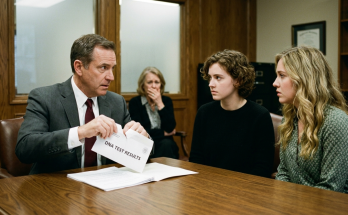
He placed a single printed page on the desk.
A legal filing.
My eyes scanned it once.
Then again.
And I understood.
Caleb had not been trying to reclaim money.
He had been restructuring debt.
Using my name.
Using the Whitmore legacy trust.
Not to destroy it.
But to bind it.
If successful, it wouldn’t have stolen the company.
It would have forced the estate into shared liability.
Which meant:
I wouldn’t have been protecting him.
I would have been protecting everything from him.
Mr. Graves spoke quietly.
“He’s not acting like a son anymore.”
I finished the thought for him.
“He’s acting like someone who learned from Henry.”
The room went still.
Because that was the part neither of us wanted to say out loud.
Henry had built an empire with discipline.
And Caleb had inherited the intelligence for it.
Just not the morality.
The Last Meeting
A week later, I asked Mr. Graves to arrange one final meeting.
Not at the house.
Not at the office.
Neutral ground.
An old property on the edge of town that once belonged to Henry’s first warehouse.
It was empty now.
Just concrete, steel, and memory.
Caleb arrived first.
No suit.
No performance.
Just standing in the middle of the space like he was measuring what used to be ours.
When I walked in, he didn’t smile.
Neither did I.
For a long time, neither of us spoke.
Then he finally did.
“You rebuilt everything without me,” he said.
I shook my head slightly.
“No,” I replied. “You removed yourself long before I did.”
His jaw tightened.
“I didn’t come here to beg.”
“I know,” I said.
That surprised him.
He looked at me more carefully now.
“What then?” he asked.
I stepped closer.
Not afraid anymore.
Not soft either.
“Tell me the truth,” I said. “Why use my name? Why now?”
For the first time, his voice dropped.
Because something in him stopped pretending.
“Because I couldn’t beat them,” he said. “And I knew you wouldn’t let them take everything.”
A pause.
Then:
“You were the only lock I knew how to open.”
That was it.
Not love.
Not hate.
Something worse.
Understanding.
I nodded slowly.
“So you were never coming back as my son.”
He didn’t answer.
Because he couldn’t.
The silence said it for him.
Ending — What Remains
The legal resolution came quietly.
No headlines.
No scandal.
Mr. Graves ensured everything was sealed, corrected, and permanently separated from Caleb’s reach.
Not destroyed.
Contained.
As for Caleb, I never saw him again after that meeting.
No more visits.
No more signals at the gate.
Only absence.
And sometimes, absence is the only honest ending people leave behind.
One evening, I stood alone in the old warehouse where everything had begun.
Dust floated in the air like memory refusing to settle.
I thought about Henry.
About Caleb.
About the difference between building something and surviving what it becomes.
I walked to the center of the floor and placed a single crystal glass there.
The same one from the dining room.
Then I stepped back.
It didn’t break.
It didn’t need to.
It just stood there in the silence, reflecting everything that had ever been lost and everything that had been preserved.
I turned and walked out.
And behind me, the warehouse stayed still.
Not empty.
Not full.
Just finished.