Chapter 1: The Architecture of a Yard
My mother, Margaret, always harbored a steadfast belief
that the truest measure of a human being could be read
in the soil of their front yard. She wasn’t referring
to the ostentatious displays of wealth—the perfectly manicured
topiaries, or the exotic, imported blossoms meticulously arranged
by hired landscaping crews simply to invoke the envy of passing neighbors.
No, she meant the mundane, unglamorous architecture of ordinary care.
She meant the quiet discipline of watering
a parched bed of soil before the leaves began to curl.
The tedious labor of plunging one’s hands into
the dirt to rip out invasive weeds before they could choke the life from the delicate shoots.
The ruthlessness required to prune back branches that had grown reckless and wild,
sacrificing present bloom for future stability.
Most importantly, she meant the sheer, uncelebrated consistency of showing up, season after season,
under the punishing July sun or the bitter November frost,
even when absolutely no one was standing by to applaud your effort.
Her own plot of land at the end of Birchwood Lane had been a living testament to that philosophy for forty uninterrupted years. It remained her sanctuary and her kingdom, especially throughout the long, quiet decades following my father’s sudden fatal heart attack when I was barely twelve years old.
Her property was a masterclass in resilient beauty. Hardy climbing roses coiled along the weathered wooden fence, standing as thorny sentinels. A pragmatic vegetable garden in the rear produced a bounty of heirloom tomatoes far exceeding what a solitary widow could ever consume. And then, there were the perennials—stubborn, loyal blooms that pushed through the thawing earth every single spring, requiring no invitation, only the memory of the sun.
But the undisputed monarch of that suburban ecosystem was the magnificent red maple anchored in the center of the backyard.
She had planted it as a fragile sapling exactly twenty-seven years ago.
It was the very same year I walked down the aisle and pledged my life to Joe.
For the entirety of my adult existence, I possessed neither the insight nor the paranoia to connect those two seemingly disparate events. I was a woman comfortably insulated by the warmth of a life well-lived. My name is Sarah Beaumont. I am fifty-three years old, and for more than a quarter of a century, I believed I knew the exact dimensions of the man I shared a bed with.
By every conceivable metric utilized by polite society, Joe was the gold standard of matrimony. He earned a steady, honorable living as a finishing carpenter, his hands rough from sanding oak and smelling faintly of sawdust and lacquer. He never vanished; when he said he would pull into the driveway at six o’clock, the tires crunched on the gravel at five-fifty-nine. Together, we navigated the chaotic, joyous trenches of parenthood, raising two remarkable daughters. Nora, now a fiercely independent twenty-four-year-old carving out a life in Portland, and Caitlin, twenty-one and navigating her final semesters of university a few hours away.
We owned a deeply comfortable, slightly creaky four-bedroom colonial. We shared an aging, golden-furred retriever named Copper, whose joints were stiff with arthritis but who still vehemently insisted on anchoring the foot of our mattress every night. To any outside observer peering through the illuminated windows of our home, our marriage appeared impermeable. Solid oak.
Yet, beneath the polished surface of our family dynamic, a singular, jagged fracture had existed almost from the very beginning.
Margaret despised Joe.
And Joe, with equal, unspoken fervor, despised Margaret.
For twenty-seven years, I cowardly rationalized their mutual antipathy as a simple, irreconcilable clash of temperaments. My mother was a woman forged in the fires of premature grief. Left entirely to her own devices at thirty-nine, burdened with a grieving tween, a mortgage, and a fledgling financial consulting firm, she didn’t shatter. Instead, she calcified. She built a highly successful business through sheer, unadulterated grit. She never entertained the idea of a second husband. She morphed into a formidable matriarch who placed her faith exclusively in ironclad preparation rather than fragile human promises, and total self-sufficiency over the vulnerability of dependence.
I worshipped her resilience, but I unknowingly absorbed the toxic byproducts of her survival mechanisms. I learned to swallow my distress. I learned to extinguish my own needs before they could inconvenience others. But above all, I mastered the dangerous art of averting my eyes. I learned just how effortlessly a person can avoid asking a question when they are utterly terrified of the answer.
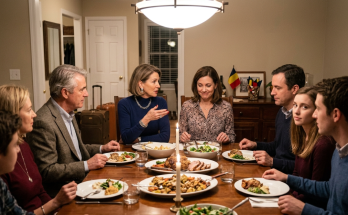
I first introduced Joe to the Birchwood Lane house when I was a naive twenty-five-year-old, drunk on the intoxicating rush of an eight-month romance. The inaugural dinner began with deceptive warmth. Mom had roasted a chicken. Joe turned on his signature, booming charm. We clinked wine glasses. But as the evening bled into the night, the atmospheric pressure in the dining room dropped drastically.
Margaret’s posture stiffened; her responses became clipped, surgical syllables. Joe, sensing the chill, overcompensated. His laughter grew too loud, his gestures too wide, taking up too much oxygen in her carefully curated space. No voices were raised. No insults were hurled across the mashed potatoes. Yet, by the time the apple tart was served, they were interacting with the calculated caution of two apex predators who had instantly recognized the lethal capacity in one another and silently agreed to a temporary ceasefire for my benefit.
They never warmed. Over three decades, they cultivated a bizarre, heavily fortified hostility. They performed civility brilliantly because they both claimed to love me. But the hum of high-voltage tension was always there, vibrating in the background of every Thanksgiving dinner and Christmas morning.
Once, when Nora was just a toddler, I was in the kitchen slicing pie while Joe and my mother were alone in the adjacent living room. Through the crack in the door, I heard Margaret’s voice, devoid of any grandmotherly warmth. It was a blade of pure ice.
“You know exactly what you did.”
The silence from my husband that followed was absolute. It wasn’t the silence of confusion; it was the suffocating silence of a cornered animal.
My hand hovered over the pie knife. I could have pushed the door open. I could have demanded context. But my pulse roared in my ears, and the cowardice my mother had unwittingly taught me seized my muscles. I retreated. I stayed in the kitchen. That dangling, venomous sentence became a piece of invisible furniture in our home—a massive, ugly object sitting in the center of the room that all three of us meticulously navigated around without ever acknowledging its existence.
Then, November arrived, carrying with it a diagnosis of Stage IV pancreatic cancer. The disease did not negotiate. By March, she was deteriorating at a terrifying velocity.
True to her nature, Margaret spent her agonizing final months executing a flawless tactical retreat from the living world. She summoned her lawyers. She legally ironed out every wrinkle in her estate. She carefully organized mountains of financial ledgers into color-coded binders. She held Nora and Caitlin’s hands, imparting stoic, tearless wisdom.
It was only at the very end, as the morphine clouded her razor-sharp mind, that her armor cracked.
I was sitting beside her hospice bed, the only sound the rhythmic hiss of the oxygen concentrator. Her papery hand suddenly gripped mine with a desperate, surprising strength.
“You…” she rasped, her eyes milky but frantically searching my face. “You have been the single best thing in my life, Sarah.”
Tears spilled over my cheeks. “And you in mine, Mom. It’s okay. You can rest.”
Her grip tightened until her knuckles turned white. Her expression shifted into a mask of pure, unadulterated anguish that will haunt me until my own dying day.
“I want you… I need you to know the truth.”
A cold prickle crawled up the nape of my neck. “What truth, Mom?”
Her eyelids fluttered, fighting the heavy undertow of the narcotics. Her lips trembled. “I was going to tell you… I always wanted to tell you. Under…”
Her eyes rolled back, and the tension left her hand. The monitors beeped in a steady, monotonous rhythm. She had drifted into a heavy, twilight coma. She would never regain consciousness. Those were the final, coherent syllables Margaret ever spoke into the world, leaving me adrift in a sea of terrifying ambiguity.
I want you to know the truth.
Chapter 2: Whispers in the Viewing Room
The funeral was scheduled on a bleak, unforgiving Saturday in late March. The sky over the cemetery was the color of bruised iron, and a biting wind whipped through the leafless branches, rattling the stained glass windows of the mortuary.
Throughout the grueling ordeal, Joe executed the role of the devoted, grieving husband with theatrical perfection. He was a stone pillar of support. He stood at my left shoulder, his heavy, warm hand resting on the small of my back. He handed out crisp tissues to weeping aunts, seamlessly managed the caterers, and navigated the endless stream of condolences with an appropriately somber nod. Whenever I felt my knees threatening to buckle beneath the crushing weight of the loss, he was there, catching me. I remember looking at his profile—the familiar crow’s feet around his eyes, the graying stubble on his jaw—and feeling a profound, desperate swell of gratitude. What would I do without him? I thought.
The reception migrated to the parlor adjacent to the viewing room. The air was thick with the scent of lilies and stale coffee. Relatives I hadn’t seen in a decade were murmuring in hushed, reverent tones.
It was during a lull in the mournful chatter that I realized Joe’s steady hand was no longer on my waist.
I scanned the crowded parlor. He was gone. A sudden, irrational panic flared in my chest—the instinctual anxiety of a child who has lost their parent in a crowd, magnified by grief. I excused myself from a conversation with a distant cousin and wandered down the heavily carpeted hallway toward the restrooms.
As I passed the partially open mahogany double doors of the viewing room, a sound arrested my momentum. It was a voice. Low, gravelly, and echoing slightly in the cavernous, empty space.
It was Joe.
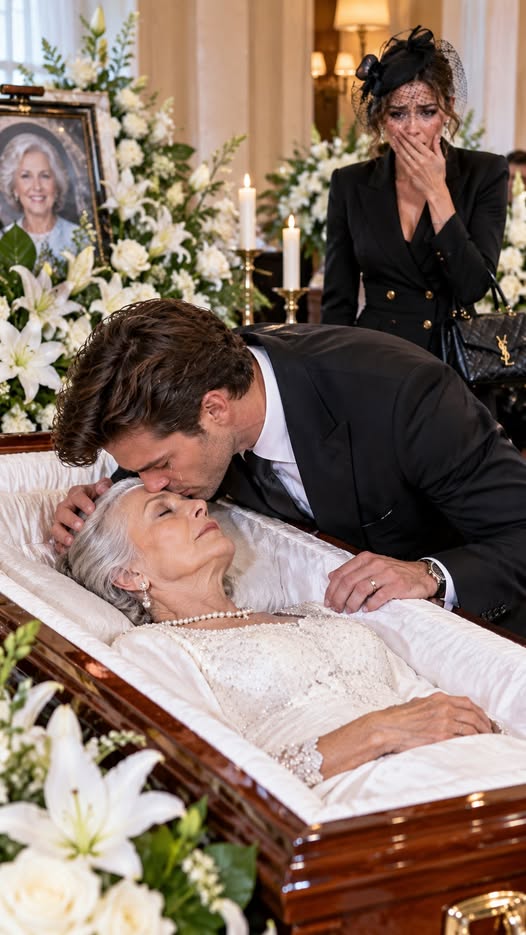
I paused, my hand resting on the brass door handle. The room was bathed in the dim, amber glow of wall sconces. Margaret’s polished cherry-wood casket sat at the far end, surrounded by suffocating floral arrangements. Joe was standing at the foot of the coffin, his back to me. His shoulders were rigid.
I opened my mouth to call out his name, assuming he was merely seeking a moment of private reflection. But before the sound could pass my lips, his words paralyzed me.
“I kept our secret, Margaret,” he whispered.
The blood drained from my face so rapidly I felt lightheaded. My breath caught in my throat.
He took a step closer to the lifeless body of my mother. “Twenty-seven years,” he continued, his voice laced with an emotion I couldn’t immediately identify. Was it relief? Malice? Resignation? “No one ever found out. You held it over my head until your dying breath, but you never broke.”
A suffocating, claustrophobic silence stretched between the living man and the dead woman. My heart hammered against my ribs like a trapped bird.
Then, he leaned forward, his hands resting on the edge of the wood, and delivered the sentence that would permanently detonate the foundation of my reality.
“It’ll stay buried under the red maple in your yard forever. Just like we agreed.”
My stomach dropped into a bottomless abyss. A physical wave of nausea washed over me. I stumbled backward, the thick carpet muffling my frantic retreat. I practically sprinted back toward the reception hall before he could turn around and see the devastating realization blooming on my face.
I rejoined the throng of mourners. I accepted a tepid cup of Earl Grey tea from an uncle. I forced the corners of my mouth upward into a grotesque pantomime of a brave, grieving daughter. I nodded. I murmured agreements. But I was entirely detached from my physical body.
Buried under the red maple.
My mind violently rewound through decades of memories, recontextualizing everything. My mother had always exhibited an eccentric, almost militant protectiveness over that specific tree. When a violent summer storm tore off a massive branch, she had hired an expensive arborist to treat the wound rather than letting nature take its course. When the thick, subterranean roots began to aggressively buckle the expensive slate walkway leading to her patio, a contractor had advised cutting it down. She had fired him on the spot and paid triple to have the entire walkway rerouted around the tree’s perimeter.
Once, about ten years ago, Joe had casually suggested that the tree was blocking too much sunlight from her prized vegetable garden and offered to bring over his chainsaw to thin it out.
I vividly remembered the scene. Margaret had stopped stirring her tea. She had turned her neck slowly, locking her glacial eyes onto Joe’s face. She stared at him in utter silence for a full, agonizing ten seconds.
“That tree,” she had said, her voice dropping to a terrifying, absolute register, “stays exactly where it is. Do not ever speak of it again.”
Joe had visibly swallowed, looked at the floor, and changed the subject. I had thought it was just another petty skirmish in their endless, invisible war.
But it wasn’t a skirmish. It was a hostage negotiation. And as I stood in the funeral home, the floral scent suddenly turning putrid in my nostrils, I knew with terrifying certainty that I could not wait for the morning to unearth the truth.
Chapter 3: Midnight Harvest
I waited until the house was entirely dark and Joe’s breathing had leveled out into the heavy, rhythmic cadence of deep sleep. He had consumed three glasses of scotch after we returned from the funeral, seeking chemical numbness.
At 10:30 PM, I slipped out from beneath the duvet, silently dressed in old jeans and a heavy wool sweater, and grabbed my car keys. I didn’t leave a note.
The drive to Birchwood Lane took twenty agonizing minutes. The suburban streets were desolate, illuminated only by the sterile, intermittent glare of streetlights. My childhood home sat at the end of the cul-de-sac, completely dark, looking like an abandoned shell. The emptiness wasn’t the temporary absence of a vacation; it possessed the cold, hollow permanence of death.
I bypassed the front door entirely and walked around the side of the house to the detached garage. The air was frigid, biting at my exposed cheeks. I hit the light switch. The fluorescent bulbs flickered to life, revealing my mother’s meticulously organized tools. I bypassed the delicate gardening trowels and went straight for a heavy, flat-headed steel spade.
I walked into the backyard. The moonlight cut through the clouds, casting long, skeletal shadows across the frost-kissed grass.
The red maple towered in the center of the lawn. Twenty-seven years of uninhibited growth had transformed it from a fragile sapling into a colossal, imposing behemoth. Its trunk was as thick as a wine barrel, its sprawling branches a massive, tangled canopy against the night sky.
I stood at the base of the tree. The wind rustled the dead leaves still clinging to the branches, sounding like dry whispers. I want you to know the truth.
I drove the spade into the earth.
The ground was stubbornly frozen, a solid block of clay and frost. The shovel bounced off the surface, sending a jarring, painful shockwave up my arms. I gritted my teeth, raised the heavy steel blade above my head, and slammed it down with all the furious strength I could muster. It bit into the dirt.
For thirty minutes, I engaged in a brutal, exhausting war with the soil. It was a nightmare of excavation. The maple’s root system was aggressive and sprawling. Thick, fibrous veins of wood crisscrossed beneath the surface like a subterranean cage. I hacked at them wildly, tears of physical exertion and emotional terror streaming down my face. My breath plumed in the freezing air. Blisters immediately began to form and tear on the palms of my un-gloved hands.
Doubt began to creep into my frantic mind. Maybe I misunderstood him, I thought, leaning heavily on the handle, gasping for oxygen. Maybe ‘buried’ was a cruel metaphor. Maybe my grief-addled brain invented the whisper at the funeral home.
I raised the shovel for one final, desperate thrust.
CLANG.
The sound was not the dull thud of wood or the scrape of a rock. It was the sharp, unmistakable, synthetic ring of steel striking metal.
My heart stopped. I threw the shovel aside and dropped to my knees in the freezing mud. I clawed at the loose dirt like a frantic animal, my fingernails tearing against the abrasive soil.
About eighteen inches down, nestled directly between two massive, coiled roots, my fingers brushed against smooth, cold metal. I dug furiously around the edges, finally securing a grip. With a guttural grunt, I hoisted the object out of the earth.
It was a heavy, military-style metal lockbox, completely mummified in several layers of decaying, yellowed plastic sheeting and thick bands of duct tape.
My hands shook so violently I could barely hold it. I carried the heavy, filthy package onto the illuminated back porch, leaving a trail of loose dirt in my wake. I found a pair of pruning shears on a nearby table and frantically sawed through the rigid plastic and tape.
The metal box wasn’t locked. The latch was stiff with rust, but it yielded to a hard yank. The lid creaked open.
Inside, protected from decades of moisture and decay, lay a single, thick manila folder.
I wiped the dirt from my hands onto my jeans, took a deep, shuddering breath, and opened it.
The very first document was a brittle, carbon-copied police report. The insignia at the top belonged to a precinct three towns over.
Date: August 14, 1996. Exactly one year before Joe and I were married.
My eyes darted down to the suspect’s information.
Name: Joseph Thomas Beaumont.
Age: 28.
My vision blurred. I squeezed my eyes shut, prayed to a God I hadn’t spoken to in years, and forced myself to read the stark, clinical type under the ‘Incident Details’ section.
Offense: Aggravated Assault.
The victim’s name was listed as Clare Ashby.
According to the responding officer’s detached narrative, Joe had been engaged in a heated verbal altercation with Miss Ashby outside a local tavern. The confrontation rapidly escalated. The suspect, heavily intoxicated, struck the victim in the face with a closed fist. The blow resulted in a severe laceration, a concussion, and a complex fracture of the victim’s nasal bone.
Blood on the pavement. An ambulance called. An arrest made.
My husband. The man who gently brushed our daughter’s hair. The man who rescued spiders in cups to put them outside. He had shattered a woman’s face in a drunken rage.
But as I scanned the bottom of the page, a stamp in red ink mocked me. CASE DISMISSED – VICTIM REFUSED TO COOPERATE.
There was no trial. No conviction. He had walked away.
Trembling, I turned the page, plunging deeper into the dark, suffocating abyss of my mother’s secrets.
Chapter 4: The Anatomy of a Secret
The documents beneath the police report formed a damning, meticulously constructed paper trail of maternal espionage.
Margaret had not simply stumbled upon this information; she had hunted for it. The next item was a copy of a letter typed on my mother’s professional business stationary, addressed to Clare Ashby. Mom had somehow unearthed a whisper of Joe’s violent past during our courtship and relentlessly tracked down the victim.
Dear Miss Ashby, the letter began. I am writing to you not as a stranger, but as a terrified mother. The man who assaulted you is currently dating my twenty-five-year-old daughter. I beg you, woman to woman, to tell me the truth about who he is.
Stapled behind it was Clare’s handwritten reply, penned on cheap, lined notebook paper. The handwriting was shaky, as if writing the words cost her physical pain.
She described Joe exactly as I had known him in our early days: intoxicatingly charming, intensely attentive, sweeping you off your feet until the exact moment his ego was challenged or he felt publicly embarrassed. She wrote that alcohol was like pouring gasoline on a smoldering ember. His temper was a sudden, terrifying detonation. She admitted she had dropped the charges because Joe’s lawyer had threatened a grueling character assassination in court, and she was simply too traumatized and financially depleted to endure the public spectacle.
But the final line of Clare’s letter felt like a physical blow to my chest.
She had underlined the four words twice in blue ink.
Please tell your daughter.
I dropped the page. The porch light buzzed above me like a swarm of angry hornets. My mind was fracturing. Why hadn’t she told me? Why, if she had this explosive proof, did she let me walk down an aisle in a white dress and bind my life to a monster?
The answer was waiting in the next document. It wasn’t evidence; it was a confession. A letter my mother had written directly to herself, dated the week before my wedding. The cursive was jagged, betraying a profound, agonizing internal crisis.
Sarah loves him with a blindness that terrifies me, the letter read. If I present these papers to her now, she will not believe the reality of them. She will accuse me of forging them because of my ‘prejudice.’ She is young, rebellious, and fiercely protective of her own autonomy. She will view this as my ultimate attempt to control her life. She will dig her heels in. She will choose him over me. She will marry him to spite me, and I will be permanently banished from her life, unable to protect her when the monster inevitably surfaces.
If I remain silent, she may someday discover the truth and hate me forever for my complicity. There is no victorious outcome. There is no good choice. There is only the choice I pray will inflict the least amount of catastrophic damage.
She had chosen silence. She had gambled my safety to maintain her proximity to me.
But Margaret was a businesswoman. She never operated without leverage. The final page of her diary detailed the true nature of the unspoken war I had witnessed for three decades.
A week before the wedding, Joe had discovered my mother’s investigation. He had come to this very house, marched into her kitchen, and sat across from her.
According to my mother’s notes, Joe leaned over the table, his eyes dark with threat, and sneered, “You’re going to be a problem, aren’t you, Margaret?”
My mother didn’t flinch. She slid a manila folder across the granite countertop. Copies of the police report. Copies of Clare’s letter.
She looked my future husband in the eye and delivered an ultimatum. “If you ever raise your voice to my daughter in anger, if you ever leave so much as a bruise on her skin, if she ever sheds a single tear of fear because of you, this original file will be overnighted to the local prosecutor, her divorce attorney, and every member of your family. I will completely and utterly destroy your life.”
Joe had stared at the papers, his bravado evaporating. “Nothing is going to happen to Sarah,” he had sworn.
“That’s correct,” my mother replied, her voice cold as the grave. “Because I am going to spend the rest of my life making sure of it.”
They forged a demonic pact in that kitchen. Joe endured decades of my mother’s psychological torture and icy disdain because she held the metaphorical gun to his head. My mother endured decades of watching the man who had battered a woman sleep next to her only child, acting as a silent, vigilant warden.
As I read the final lines of her diary, the ink was smeared, warped by decades-old tears.
I wanted to protect her. God forgive me, I hope that is what I accomplished. I hope the fear of me made him a better man. But the terror never leaves me. I don’t know if he changed.
I sat on the freezing porch for hours. The sky began to bleed into a bruised, pre-dawn gray.
Suddenly, twenty-seven years of agonizingly polite family dinners, the rigid posture during holidays, the sharp, loaded comments muttered over roasting turkeys—it all shattered and reassembled into perfect, horrifying clarity.
My mother had not been a judgmental shrew. She had been a sentry standing guard on the wall. And Joe knew every time she looked at him, she wasn’t seeing a son-in-law; she was seeing a convict on parole.
My fingers, numb from the cold, fumbled for my cellphone. I dialed Patricia. She was a razor-sharp family-law attorney and one of my oldest confidantes.
She answered on the fourth ring, her voice thick with sleep. “Sarah? It’s five in the morning. Are you okay?”
I didn’t greet her. I just started talking. I poured out the story in a frantic, unbroken torrent—the funeral, the whisper, the midnight drive, the digging, the police report, Clare, the blackmail.
When I finally ran out of breath, Patricia didn’t offer platitudes. Her legal mind engaged instantly.
“Do you have the physical documents in your possession right now?”
“Yes. They’re on my lap.”
“Are you in immediate physical danger? Does Joe know you left?”
“I’m at my mother’s house. He’s asleep at home.”
I heard her exhale deeply into the receiver. “Okay. Listen to me, Sarah. From a strictly legal standpoint, an assault charge from 1996 that was dismissed is entirely un-prosecutable. The statute of limitations expired while we were in our twenties. But from a matrimonial standpoint… these documents change the entire landscape of your divorce, especially if we can establish a pattern of coercion or if you have any current fears for your safety.”
“Divorce?” The word sounded alien, heavy and grotesque on my tongue. “I… I don’t know what I’m trying to do.”
I looked out across the dark lawn at the massive silhouette of the red maple. It looked like a giant, silent witness.
“That’s completely fine, Sarah,” Patricia said gently, her lawyer persona softening. “You don’t have to solve a twenty-seven-year-old conspiracy tonight. Just stay safe.”
“Patricia?” I asked, my voice cracking. “Do you think my mother did the right thing? Hiding it?”
A heavy silence stretched across the cellular network. The kind of silence that requires profound thought.
Finally, Patricia answered. “As an attorney? I think she was dead wrong about the strategy. She robbed you of your agency.” A pause. “But as a mother? I think she was absolutely right about the love.”
I hung up the phone. I packed the papers back into the rusty metal box, placed it on the passenger seat of my car, and drove back to the life that had been a lie.
I unlocked my front door as the first rays of morning sun hit the windows. I walked silently up the carpeted stairs and stood in the doorway of the master bedroom.
Joe was sprawled across the mattress, snoring softly, one arm thrown over the empty space where I usually slept.
I stood there, paralyzed by cognitive dissonance. I looked at the man in the bed. This was the man who had spent three sleepless nights rocking a feverish Caitlin when she was a toddler. The man who brewed my specific, complicated coffee order every single morning without being asked. The man who had never, in ten thousand days of marriage, raised a hand to me, threatened me, or made me feel an ounce of physical fear.
But superimposed over his sleeping face was the ghost of a twenty-eight-year-old stranger in a bar parking lot. Drunk. Feral. A closed fist striking bone. A woman screaming, her face ruined.
And somewhere in the shadows of this room stood my mother, her arms crossed, watching him, making sure he never forgot the blade she held to his throat.
Had Joe truly been rehabilitated by love, time, and fatherhood? Or had he simply been caged by a mother’s ruthless blackmail?
If a violent man is forced to act like a good man under threat of destruction, does he eventually become a good man? Or is he merely a monster on a leash?
I didn’t know the answer. But I knew I couldn’t get into that bed. I turned, walked downstairs, and curled into a ball on the living room sofa, waiting for the monster to wake up.
Chapter 5: The Stranger in My Bed
I did not sleep. I stared at the ceiling plaster as the house slowly warmed with the morning sun. At 7:00 AM, I heard the familiar, heavy thud of Joe’s footsteps on the oak stairs.
He walked into the living room, wearing a faded gray t-shirt and sweatpants, his hair rumpled. He stopped when he saw me on the couch, still wearing my dirt-stained jeans and wool sweater from the night before.
His brow furrowed in genuine concern. “Sarah? You slept down here?”
I sat up slowly. My joints ached from the physical labor of the grave-digging. “I couldn’t sleep.”
He took a step closer, noting the mud caked on the knees of my pants. “Where did you go last night? The car was gone when I woke up to use the bathroom.”
I stared at his face. I searched his eyes for the monster Clare Ashby had described. I saw only my husband. It made me sick.
“Joe.”
I didn’t shout. I didn’t cry. I spoke his name with a terrifying, hollow flatness.
He stopped moving. The easy concern wiped from his face, replaced by a sudden, primal hyper-vigilance. My tone was a foreign frequency he hadn’t heard in twenty-seven years.
“Yes?” he asked, his voice tight.
I let the silence hang in the air for five seconds. Let him suffocate in it.
“I heard you at the funeral home yesterday.”
Joe stopped breathing. His chest froze mid-inhale.
“I was walking past the viewing room,” I continued, my voice a relentless, steady drumbeat. “I heard what you confessed to my mother’s coffin.”
Absolute, paralyzing silence filled the room. The hum of the refrigerator in the kitchen suddenly sounded deafening.
“You told her you kept your secret.”
A microscopic tremor ran through Joe’s hands. He slowly lowered himself into the armchair opposite the couch, as if his legs could no longer support his weight.
“You said it would stay buried under the red maple.” I leaned forward, resting my elbows on my knees. “I drove to Birchwood Lane last night, Joe. I broke the frozen earth. I dug it up.”
The blood completely vanished from his face. He looked aged a decade in ten seconds. He didn’t deny it. He didn’t feign confusion. He stared at the coffee table, his eyes locked on a coaster.
“She kept them,” he whispered, his voice cracking. It was a statement, not a question.
“Every single page,” I confirmed coldly. “The police report. The letters. Her diary outlining your little extortion pact.”
Joe dragged both hands down his face, a gesture of profound, utter defeat. “I thought… as the years went on, as I proved myself to her, I thought she might have destroyed them. A gesture of forgiveness.”
Then, he looked up at me, his eyes rimmed with red, and admitted something that sent a fresh shock of horror through my system.
“Three years ago,” he said, his voice barely audible. “When Margaret had that mild heart attack and was in the cardiac ward for a week. I drove over there in the middle of the night. I took a shovel to the backyard. I dug down until I hit the metal box. I just wanted to see if it was still there.”
My jaw clenched. “And it was.”
“It was.”
“Why didn’t you take it?” I demanded, my voice rising in anger. “Why didn’t you dig it out and burn the evidence right then and there?”
Joe shook his head slowly. “Because she would have known. The soil would have been disturbed. The roots cut. She inspected that tree every day. If the box was gone, she would have known I took it.”
“And then your deal would have been broken,” I spat out, the venom finally leaking into my tone. “The deal where she stayed silent about you beating a woman half to death, and you promised not to put me in the hospital.”
Joe flinched as if I had physically struck him. “That… that isn’t how I would describe what happened.”
“How would you describe it, Joe?!” I yelled, the dam finally breaking. “How would you describe a mother blackmailing a violent criminal to ensure her daughter’s physical safety?”
He had no rebuttal. He looked at me, his eyes entirely stripped of defenses.
“Your mother was protecting you.”
He said it without a shred of hesitation. No anger. No resentment toward the woman who had terrorized him for decades. Just an absolute, factual acknowledgement.
“Yes,” I whispered, the fight suddenly draining out of me, leaving only exhaustion. “She was.”
Chapter 6: A Quarter-Century of Silence
The sun was fully up now, casting harsh, unforgiving light across the living room.
“Tell me,” I demanded, crossing my arms over my chest, suddenly feeling freezing cold. “Tell me your side. I want to know who I married.”
And so, Joe unburdened himself of twenty-seven years of suppressed guilt.
He didn’t make excuses. He told me that in 1996, he was a deeply broken, volatile, and toxic human being. He used alcohol not as a social lubricant, but as a weapon to obliterate his insecurities. He confessed that his temper was a hair-trigger, fueled by an arrogant need to control every room he walked into.
He told me about Clare. He didn’t minimize it. He confirmed the police report was entirely accurate. He was drunk. She insulted his ego. He lost his mind. He hit her with full force, watched her crumple to the pavement in a spray of blood, and then he ran away into the night like a coward because he was terrified of going to prison.
“I was a monster, Sarah,” he said, tears finally spilling over his eyelashes. “A violent, pathetic monster.”
He told me that the incident broke something inside him. The sheer horror of what he had done shocked him into action. Before he even met me, before Margaret ever found out, he had quit drinking cold turkey. He had checked himself into intensive anger-management therapy twice a week for two years.
I stared at him, stunned. “Therapy? You went to therapy for two years and never told me?”
“I couldn’t tell you,” he pleaded. “If I told you I was in therapy for rage, you would have asked why. And I was terrified that if I told you about Clare… I would lose you.”
“So you built our entire marriage on a lie of omission.”
“I have lived in terror for twenty-seven years,” Joe said, his voice breaking into a sob. “Every time the phone rang late at night, every time your mother looked at me across the Thanksgiving table, I was terrified you would find out.”
“Because you thought I’d believe you were capable of hurting me?”
Joe looked me dead in the eye. “Because you would be entirely justified in wondering.”
He didn’t blame Clare for exaggerating. He didn’t use the alcohol as a crutch. He took complete ownership of the violence.
“I did a terrible, unforgivable thing,” he said quietly. “But I swear to God, Sarah. I haven’t raised my voice in anger, let alone my hand, to another human being since that night.”
I looked at his hands. The hands that built our kitchen cabinets. The hands that held mine during childbirth.
“Why, Joe?” I asked, my voice trembling. “Is it because you truly did the work and changed? Or is it because you knew my mother had a loaded gun pointed at your head, waiting for you to slip up?”
Joe let out a shuddering breath and looked down at his lap.
“I honestly don’t know.”
The admission chilled me to the bone.
“Maybe the therapy rewired my brain,” he continued, speaking to the floor. “Maybe getting sober saved me. Maybe falling in love with you and holding Nora for the first time changed my soul. But… maybe knowing Margaret was watching my every move kept me in line when I wanted to break. It was probably all of it.”
“That is a terrifying thing not to know about your own soul, Joe,” I whispered.
“I know,” he replied. “It is.”
I asked him if he ever tried to make amends to Clare. He admitted he hadn’t. He was too cowardly. He was terrified she would ruin his new life.
I stood up from the couch. The room felt incredibly small, the air too thin to breathe.
“I need time,” I said. “I can’t look at you right now. I don’t know who you are.”
Joe didn’t argue. He didn’t beg. He simply nodded, his shoulders slumped in absolute defeat. He walked upstairs, packed a small duffel bag with a few days’ worth of clothes, and said he would go stay in the spare bedroom of his brother’s house across town.
Before he walked out the front door, he paused in the foyer. He turned back to look at me standing in the kitchen.
“Sarah.”
“What?” I snapped, my patience entirely depleted.
“Your mother was right about something.”
I let out a harsh, bitter laugh. “She was right about a lot of things, Joe. It turns out her paranoia was entirely justified.”
“Yes,” he agreed softly. “But I mean one thing in her diary in particular.” He gripped the handle of his duffel bag until his knuckles turned white. “If she had shown you those police reports when you were twenty-six… I think you would have chosen me.”
I opened my mouth to furiously deny it, to tell him I would have run for the hills. But the words died in my throat.
“I think,” Joe continued, his eyes full of sorrow, “you would have believed my tearful apologies. You would have believed it was an isolated, drunken mistake. And you would have resented your mother for trying to sabotage our love. You would have pushed her away.”
The most agonizing part of the entire morning was that I knew, deep in the darkest corners of my own heart, that he was probably right.
At twenty-six, I was wildly, defiantly in love with him. I was desperate to prove my independence from my domineering mother. If she had demanded I leave him, I likely would have dug my heels in, defended him, and fractured my relationship with her forever.
“I’m not saying she was right to manipulate us, Sarah,” Joe said, his hand resting on the doorknob. “But as a father to two daughters now… I always understood why she did it.”
The door clicked shut behind him, leaving me alone in a house echoing with a quarter-century of ghosts.
The question paralyzing my mind was no longer a matter of guilt. Joe had committed a brutal act of violence. That was an undisputed fact.
The impossible question was: what did twenty-seven years of exemplary, loving behavior mean when weighed against one monstrous act that had been concealed through blackmail? Did a lifetime of penance erase a moment of brutality?
Did a man who once shattered a woman’s face remain forever identical to the man who did the shattering?
And looming over all of it was the phantom of my mother, Margaret. A woman who carried the crushing, suffocating weight of this secret in absolute silence, trading her own peace of mind to construct a fortress around mine.
Chapter 7: The Roots We Leave Behind
The house felt intolerably silent over the next forty-eight hours. I existed in a fugue state, drinking cold coffee and staring at the walls.
Eventually, I picked up my phone and called Nora.
I didn’t sugarcoat it. I told my twenty-four-year-old daughter that her father and I were separating for an undetermined amount of time.
Nora possessed her grandmother’s sharp, analytical instincts. Her first question wasn’t why.
“Mom. Are you safe? Has he hurt you?”
“I am completely safe,” I assured her, my voice cracking at the tragic necessity of the question.
Then, I told her the entire, ugly saga. The funeral whisper, the midnight excavation, the police report, Clare Ashby, the blackmail pact, and her father’s confession.
Nora remained dead silent for the duration of the story. I could hear the gears turning in her mind, re-evaluating her entire childhood, restructuring her hero-worship of her father.
When I finally finished, she let out a long, slow breath.
“Grandma Margaret kept those police files buried under a tree in the dirt for twenty-seven years?”
“Yes.”
“Because she was terrified of him, but terrified of losing you?”
“Yes.”
“And Dad knew she had them the entire time?”
“He knew.”
Nora went silent again. The generational gap in how we processed trauma was vast. Where I felt betrayal, Nora seemed to immediately grasp the tragic, warped mechanics of survival.
“What are you going to do, Mom?” she finally asked.
“I don’t know, Nora. I honestly don’t know if I can ever look at him without seeing blood on his hands. But I also don’t know how to throw away thirty years of a good life.”
Her response floored me with its maturity.
“That’s okay, Mom,” she said softly.
“Is it?” I cried. “I feel paralyzed.”
“Yes, it is. You just found out your entire adult life was built on a Cold War between the two people you loved most. Taking time isn’t a sign of weakness. It’s not the same as making a decision. It’s just giving yourself permission to breathe.”
After I hung up with Nora, my thoughts drifted away from Joe and settled entirely on Margaret.
I thought about the red maple.
I remembered the spring she had planted it. I was in the yard, watching her pack the soil around the fragile roots. I had asked her why she chose a maple instead of a flowering cherry tree or an oak.
“I want something that will grow,” she had replied, wiping sweat from her brow. “Something that will anchor itself so deeply into the earth that no storm can ever rip it out.”
For twenty-seven years, I assumed she was talking about the arboreal beauty of the tree.
Now, the metaphor cracked open, revealing its tragic core. The tree wasn’t just landscaping. It was a monument. It marked the exact geographical location where she had buried the ugly, terrifying truth she couldn’t bring herself to speak aloud.
As the tree grew, so did the weight of the secret. The roots pushed deeper, twining around the metal box, locking it in place. The trunk expanded, solidifying the lie. The branches stretched wide over the yard, casting a massive, protective shadow over our lives. When the roots grew so violently they cracked the pavement of her walkway, she refused to cut it down. She wasn’t being sentimental about a plant. She was protecting the vault.
A few days later, the chaotic storm in my mind finally settled into a dull, manageable ache. I grabbed my car keys and drove back to Birchwood Lane one last time.
I walked into the garage and retrieved my mother’s worn leather gardening gloves.
I walked into the backyard and stood beneath the sprawling canopy of the red maple. The afternoon sun filtered through the branches, casting a beautiful, dappled light across the grass. The tree was majestic. The sinister nature of what it guarded did not diminish its physical beauty.
I knelt beside the jagged, muddy crater I had hacked into the earth nights before. The rusted metal box was sitting in the trunk of my car, destined for a shredder or a lawyer’s desk—I hadn’t decided yet.
But the hole remained. An ugly, gaping wound in my mother’s perfect yard.
Slowly, methodically, I used my gloved hands to push the displaced soil back into the earth. I packed the dirt down firmly around the exposed roots, burying the empty space. I pressed the soil flat, smoothing it over until it blended with the surrounding lawn.
I stood up, my knees popping, and brushed the dirt from my jeans. I looked up the massive, scarred trunk of the maple, tracing the branches as they reached for the sky.
“Thank you,” I whispered into the quiet yard.
I don’t know if I was speaking to the spirit of my fiercely protective, deeply flawed mother, to the silent, stoic tree, or simply to the invisible space she had occupied in the chaotic theater of my life.
Perhaps it was all three.
Margaret had been wrong to keep the truth from me. I firmly believe that now. She had stripped me of my right to choose my own fate, operating under the arrogant assumption that she knew better.
But her actions were not born of malice or a desire to control. They were born of absolute, paralyzing fear. They were born of a fierce, desperate, feral love that convinced her she could stand in the gap between her only child and destruction, absorbing the psychological toll so I wouldn’t have to.
For twenty-seven years, the truth lay dormant beneath the soil. Protected. Preserved. Waiting for the day the earth would shift.
My mother had whispered on her deathbed: “I want you to know the truth.”
She had run out of time to speak the words herself, but she had meticulously left me the map to find it. The lockbox was rusted, but it was never truly locked. It was heavily shielded from the rain and the rot, but not from the hands of the daughter who was eventually meant to unearth it.
I think, in her heart of hearts, Margaret always knew that someday I would dig it up.
Not when I was twenty-six. Not when I was young, arrogant, and foolish enough to confuse blind passion with unbreakable certainty.
But later.
She waited until I was fifty-three. Until I had lived enough life, absorbed enough pain, and witnessed enough complexity to understand that human beings are rarely one thing or the other.
That a woman can love her daughter more than life itself and still make a catastrophically wrong decision in the name of that love.
That a man can commit an act of unspeakable violence, and then spend three decades desperately trying to outrun the monster he was, building a beautiful life on a foundation of terror and regret.
That a “perfect” marriage can contain a secret so massive, so heavy, that its revelation forces you to completely rewrite the history of every single day that preceded it.
I am fifty-three years old. I raised two brilliant daughters who are strong enough to handle complicated, ugly truths.
And as I walked away from the red maple and back to my car, I realized that now, I finally had to learn to do the exact same thing.
Some things in this life are planted because we want to watch them bloom and grow toward the sun.
But others… others are planted because we desperately need a silent sentinel to stand guard over the terrifying things we cannot yet bear to face. And sometimes, decades later, when the storms have passed and the roots have settled, we finally become strong enough to dig into the dark earth, break our nails, and discover what was patiently waiting for us all along.