Chapter 1: The Wreckage and the Ruse
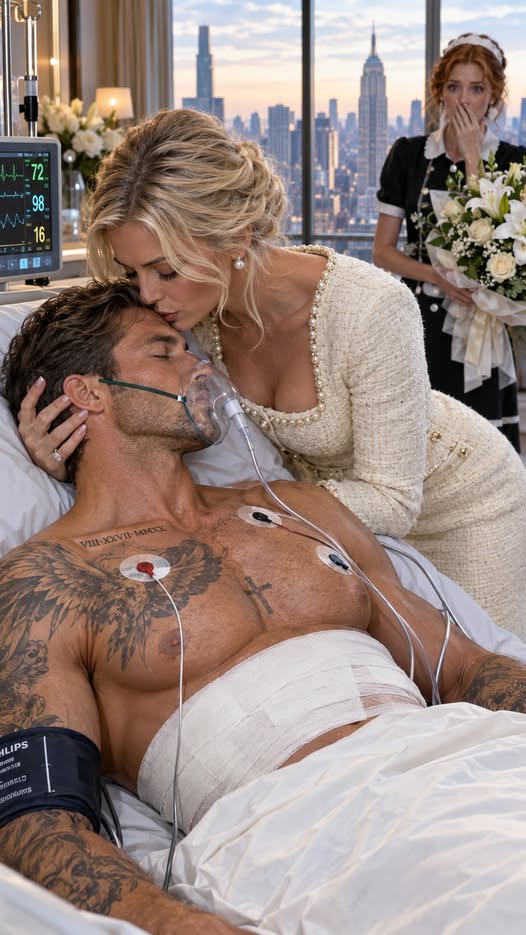
She kissed my forehead, her lips lingering against my
bruised skin with the practiced tenderness of a grieving widow.
She was utterly convinced I was trapped inside a dark, irreversible coma,
but I heard every poisonous word that slithered from her mouth.
I felt the ambient temperature of the room drop.
And minutes later, the maid whom everyone treated like a piece of
invisible furniture would discover the terrifying truth—a truth that
could easily get us both killed before the sun rose over the East River.
Five nights earlier, the reality I thought I controlled had violently shattered.
My armored Bentley Continental had been tearing down the FDR Drive,
the midnight lights of the Brooklyn skyline blurring into a ribbon of neon fire.
I had been in the backseat, reviewing the quarterly acquisitions for
Vance Enterprises, when the vehicle suddenly lunged forward, untethered from physics.
My driver, Nico, a man who had driven me for fifteen years and
who had a six-year-old daughter whose artwork covered his sun visor,
slammed his heavy boot onto the brake pedal.
Nothing happened.
I looked up just in time to see Nico’s terrified eyes in the rearview mirror.
The brake line hadn’t just failed;
it had been surgically, intentionally severed.
We hit the concrete median at eighty miles an hour.
The sound of tearing metal was deafening,
a catastrophic mechanical scream that vibrated through my teeth.
The armored glass spider-webbed,
the airbags deployed with the force of a detonating bomb,
and the world violently spun into a kaleidoscope of blood,
shattered fiberglass, and agonizing blackness.
Nico died instantly. The steering column crushed his chest before he could even draw a final breath.
I woke up in the back of a screaming ambulance, the erratic strobe of red and blue lights violently painting the inside of the cabin. My ribs felt as though they had been pulverized with a sledgehammer. A thick, metallic coating of blood coated my tongue, slipping down my throat and making me gag. But as the paramedics barked vitals and clamped oxygen over my face, one single, terrifying thought burned hotter than the agony in my chest.
Whoever wanted me dead knew exactly where I would be. They knew my schedule. They knew the blind spots in my garage’s security grid. This wasn’t a rival corporation or a faceless enemy. The call came from inside the house.
I grabbed the wrist of my private trauma physician, Dr. Aris Thorne, who had ridden in the ambulance with me. My fingers dug into his scrubs with a desperate, crushing grip.
“Julian, lie still,” he ordered, his eyes wide. “You have multiple fractures. A severe concussion—”
“Tell them,” I rasped, spitting blood onto my own chin, my vision swimming. “Tell them I’m gone inside. Brain dead. Coma.”
Aris stared at me, the paramedic beside him pausing with a syringe mid-air. “Julian, what are you talking about? You need immediate—”
“They cut the brakes, Aris,” I hissed, the darkness pulling at the edges of my consciousness. “If they know I survived… they will finish it in the ICU. Tell them I am a vegetable. Tell them the lights are out.”
I didn’t wait for his answer. The pain finally dragged me under, pulling me into a deep, merciful abyss.
By sunrise, the financial capitals of the world believed that Julian Vance, the forty-six-year-old titan of Wall Street, was locked in an irreversible vegetative state.
My injuries were brutally real.
The coma was not.
For five agonizing days, I lay entirely motionless in a high-security, private suite on the ninth floor of the Vance Medical Pavilion in Manhattan. I was a prisoner inside my own shattered body. I had to train myself to breathe with the shallow, rhythmic, mechanical cadence of the dying. I could not flinch when the nurses aggressively adjusted my IV lines. I could not groan when the deep tissue bruises across my spine throbbed in time with my heartbeat.
I became a ghost, haunting my own deathbed. And from that silent purgatory, I watched the people I had trusted for decades begin to circle my mattress like starved vultures sensing decay.
My long-time consigliere, a man who had eaten at my dinner table every Thanksgiving, stood by the window and wept—not for me, but for the loss of his unparalleled access to my capital.
My cousin, Anthony Vance, a man whose entire career I had subsidized, stood at the foot of my bed and calmly discussed “modernizing the family portfolio” and “trimming the fat” of my philanthropic foundations.
I listened as a prominent state senator, a politician whose entire reelection campaign I had single-handedly funded, promised Anthony his unwavering legislative support for a “smooth corporate transition.”
Even my chief legal counsel, Arthur Penhaligon, stood over my unmoving body and clinically outlined the emergency protocols to seize control of my blind trusts and offshore liquidity.
Lying there in the dark, the rage inside me built into a localized nuclear reactor. I wanted to snap my eyes open. I wanted to reach up, grab Arthur by his silk tie, and destroy their entire worlds.
Instead, I endured. I cataloged their treachery. I memorized every betrayal.
But the true horror had yet to reveal itself. It wasn’t the lawyers or the politicians that broke my heart.
It was the woman I was supposed to marry.
The door to my suite clicked open, and the heavy, intoxicating scent of Tom Ford Black Orchid rolled into the room, signaling the arrival of the apex predator.
Chapter 2: The Whisper in the Dark
When the nurses and attending physicians were in the room, my fiancée, Chloe, performed her grief with the flawless, calculated precision of an actress desperately chasing an Academy Award.
She wore exclusively black silk. She abandoned her signature red lipstick, replacing it with a pale, tragic gloss. She would sit in the chair beside my bed, holding my limp, bruised hand, and allow exactly one perfectly timed, glistening tear to slide down her immaculate cheek while the cameras flashed through the narrow glass window of the door.
“He was my entire world,” I heard her sob to the Chief of Medicine on the third day. “I don’t know how I will draw breath without him.”
But the second the heavy oak door clicked shut, sealing us in the soundproof suite, the grieving widow vanished, replaced by something reptilian and cold.
She would drop my hand as if my skin diseased her. She would pace the hardwood floor, her designer heels clicking with agitated, aggressive rhythm.
“You should’ve signed the asset transfers when I asked you last month,” she hissed on the fourth evening, standing so close to the bed I could feel the heat radiating from her body. “But no. You always had to be the smartest man in the room. You always had to control the board.”
I kept my eyelids still. I slowed my heart rate down, relying on the meditative breathing techniques I had learned decades ago. Breathe shallow. Do not let the monitor spike. Do not let her see the trap.
The next day, she stood by my ear and called me an old man.
I was forty-six. I had built an empire from the ashes of my father’s bankruptcy. I had given her a life of unmitigated luxury, a penthouse overlooking Central Park, and a platinum ring that cost more than a commercial airliner.
Then came the fifth afternoon.
The sky outside the reinforced window had turned a bruised, violent purple as a winter storm rolled over the city. The room was dim, illuminated only by the sterile, blinking lights of the medical machinery keeping my ruse alive.
Her perfume reached me long before her breath touched my ear. I felt the mattress dip slightly as she leaned her weight onto the edge of the bed. Her perfectly manicured fingernails lightly traced the collar of my hospital gown.
“Die before Friday, Julian,” she whispered, her voice a velvety, lethal caress. “The money moves so much faster when you finally stop breathing.”
Every muscle, every nerve, every fiber in my battered body screamed for me to reach up, wrap my hands around her slender throat, and squeeze until that smug, arrogant voice was permanently silenced. The adrenaline hit my bloodstream like battery acid. The heart monitor beside my bed gave a singular, erratic blip.
I immediately forced my body to go entirely slack. I envisioned the icy waters of the Atlantic. I pushed the rage down into a tight, black box in the center of my mind.
Chloe lingered for a moment longer, seemingly satisfied with her monologue, before turning on her heel and strutting out of the room. The door clicked shut.
I was alone with the steady hum of the machines.
Three minutes later, a much softer, more hesitant set of footsteps entered the suite.
“Mr. Vance?” a voice murmured.
It was Elena Miller.
She was a young woman who had been cleaning my Wall Street penthouse for the last six months. She was perpetually quiet. Utterly invisible. She was exactly the kind of woman that people like Chloe spoke around, simply because they never considered a woman in a maid’s uniform important enough to notice.
I listened to the rustle of plastic as Elena moved toward the nightstand, replacing the wilting white lilies that Anthony had hypocritically sent the day before.
“I hate these things,” Elena murmured to herself, her voice barely louder than the hum of the oxygen concentrator. “They smell like a funeral home trying to pretend it’s a wedding.”
Despite the stabbing pain in my fractured ribs, I nearly smiled. It was the first honest sentence I had heard in five days.
I felt the soft, unexpected weight of the cotton blanket being pulled up and tucked carefully over my exposed shoulder. She wasn’t doing it because a doctor was watching. She wasn’t doing it for an inheritance. She did it simply because she thought a dying man might be feeling the chill of the hospital air.
“I heard her,” Elena whispered, her voice suddenly dropping into a terrified, trembling register.
My internal heartbeat sharpened. The monitor ticked slightly faster.
“I heard Miss Chloe yesterday in the hallway too,” Elena continued, taking a step back from the bed. “She was on her cell phone. She told someone that grief is only useful if the press is there to photograph it.”
I heard the sound of Elena swallowing hard, her breath shuddering.
“People like me… we get paid to pretend we don’t hear things, Mr. Vance,” she said, her voice laced with a deep, pervasive anxiety. “We empty the trash. We scrub the floors. We are supposed to be deaf.”
She moved closer to the bed. I could sense her hovering just inches away from my face.
“But what she said to you just now… that wasn’t grief, Mr. Vance.”
Her voice trembled so violently I thought she might cry.
“That was a countdown.”
Silence swallowed the room, heavy and thick.
“I think they’re planning to finish what that car crash didn’t,” Elena whispered, the terrifying realization hanging in the air.
Instinctively, seeking some kind of human comfort in the face of absolute darkness, her fingers lightly brushed against my knuckles resting atop the blanket.
I made my decision.
I isolated the motor functions in my hand, bypassed the agony in my chest, and slowly, deliberately, moved my smallest finger, hooking it over hers.
Elena completely froze.
Her breath caught violently in her throat as I slowly, agonizingly, peeled my eyelids open. The harsh fluorescent light burned my retinas, but as my vision cleared, I saw her face turn the color of bleached bone.
Before the shock could compel her to scream and alert the guards in the hallway, I forced out the first words I had spoken in five days.
“Lock the door.”
Chapter 3: The Awakening
Elena stared down at me with wide, terrified eyes, looking exactly as though a corpse had just sat up in a coffin and asked for a glass of water.
For several agonizing seconds, neither of us dared to breathe. The only sound was the steady, rhythmic beep-beep-beep of the heart monitor I was actively trying to suppress.
“Please,” I rasped, the word tearing through my throat like shattered glass. My vocal cords were dry, tight, and unused. “Elena. Lock it.”
The sound of her own name seemed to snap her out of her paralysis. She spun around, her rubber-soled shoes squeaking softly against the linoleum, and crossed the room. With trembling fingers, she twisted the heavy deadbolt on the suite door. Then, showing a remarkable presence of mind, she reached up and yanked the privacy curtain across the narrow glass panel, blinding the hallway to the interior of my room.
When she returned to my bedside, she was clutching her cleaning apron as if it were body armor. Her skin was still hauntingly pale.
“You’re… you’re awake,” she stammered, stating the impossible.
“Apparently,” I replied, shifting my weight against the pillows. A sharp, blinding spike of pain radiated from my fractured ribs, forcing a grimace onto my face. My voice sounded like gravel being slowly dragged across rough concrete.
Elena glanced nervously toward the ceiling corners, her eyes searching the shadows. “Cameras?”
“Not in patient rooms,” I assured her, taking a shallow, carefully measured breath. “Privacy laws.”
“You’re entirely sure?”
“I own thirty percent of this hospital network, Elena. I approved the security architecture myself.”
Her eyebrows lifted, a momentary flash of disbelief cutting through her fear. Despite the sheer, suffocating gravity of the situation, the corners of my mouth twitched upward.
“I suppose that explains why you have a private elevator that opens directly into this suite,” she noted.
“Among other things,” I murmured.
I stared at her, assessing the woman standing before me. She was perhaps twenty-eight, her dark hair pulled back into a severe, practical bun, her uniform pristine but faded from years of industrial washing. She had walked into a room to change flowers and had stumbled into the epicenter of a multi-billion-dollar assassination plot.
“You shouldn’t be here,” I told her, my tone darkening with genuine concern. “If Chloe or my cousin Anthony finds out that you know I am conscious, they will not simply terminate your employment, Elena. They will ensure you vanish. You have no idea what these people are capable of.”
“I saw the men she talks to in the hallway,” Elena countered, her voice dropping to a fierce, hushed whisper. “They wear expensive suits, but they carry themselves like thugs. They aren’t estate planners, Mr. Vance. I know what dangerous men look like.”
“They are corporate mercenaries,” I confirmed, forcing my lungs to expand a fraction more. “And yet, you are still standing here. You locked the door instead of running. Why?”
Elena looked down at her hands, her fingers twisting the fabric of her apron. When she looked back up, her dark eyes were shining with a fierce, unexpected loyalty.
“Because you were good to my brother,” she whispered.
I frowned, sorting through the filing cabinets of my memory, trying to attach a face to her words.
“When David got sick last year,” Elena explained, her voice thick with emotion, “he required three rounds of experimental chemotherapy. We couldn’t afford it. The insurance companies denied the claims. We were drowning in medical debt, facing eviction. And then, one afternoon, the hospital billing department called and told us the balance was zero.”
She took a step closer, her gaze unwavering.
“Your office paid it. Your philanthropic foundation cleared his bills, completely anonymously. You didn’t even know my name, Mr. Vance. You never once looked at me when I vacuumed your rugs. But you saved his life. People like Miss Chloe think the support staff are invisible. They think we are deaf and dumb. We aren’t. We just remember who treats us like human beings, and who treats us like dirt.”
A cold, calculating clarity settled over my mind, temporarily numbing the physical pain of my broken body. For five days, I had been a helpless observer trapped in my own tragedy, waiting for my enemies to reveal the full scope of their hand. Now, because of a random act of corporate charity I barely remembered signing off on, the final, fatal card was laid bare before me.
“Friday,” I said, my voice growing stronger as the adrenaline flooded my veins, clearing the lingering fog of the painkillers. “Chloe mentioned a countdown. She said to die before Friday. Why Friday?”
Elena reached deep into her apron pocket. Her fingers emerged holding a crumpled, heavily folded piece of heavy stock paper. It was a discarded draft she must have retrieved from the suite’s wastebasket.
She smoothed it out against the edge of the mattress.
“She was on the phone with your cousin Anthony yesterday afternoon while I was mopping the adjacent corridor,” Elena explained, pointing to the printed text. “They are triggering the emergency succession clause in your corporate charter. The vote happens at midnight on Thursday. If you are officially declared brain-dead or deceased by Friday morning, full voting control of Vance Enterprises legally shifts to Anthony.”
I stared at the document. It was a drafted press release announcing my tragic passing.
“And Chloe?” I asked, my voice dangerously calm.
“The trust automatically liquidates forty percent of its offshore liquidity—nearly two billion dollars—directly into a shell company registered under her maiden name in the Cayman Islands as a ‘grieving widow’s severance’,” Elena finished.
“They didn’t just cut my brake lines and kill Nico,” I murmured, a dark, predatory smile touching my lips. “They bought my entire inner circle.”
“What are we going to do?” Elena asked, her breath hitching as the reality of our isolation set in. “They have private armed guards stationed on the main elevator floor. The attending physician overseeing this floor, Dr. Harrison… he’s in on it too, Mr. Vance. I heard him tell Miss Chloe that the ‘final dosage adjustment’ would happen tonight. During the 2:00 AM round.”
“Harrison,” I muttered, the name leaving a foul taste in my mouth. I had personally donated ten million dollars to his cardiac research wing three years ago. Treachery, it seemed, was the only currency with guaranteed inflation in Manhattan.
“Mr. Vance, if he administers a lethal cardiac compound, you won’t live to see the sunrise,” she pleaded.
“Elena,” I said, reaching out to firmly grasp her wrist. My fingers were bruised and pale, taped with medical gauze, but my grip held the absolute, terrifying authority of a man who had built a billion-dollar empire from scratch. “Listen to me very carefully. Can you get down to the basement maintenance hub without crossing the primary security checkpoints?”
She nodded instantly, her jaw setting with determination. “I have clearance for the service utility corridors. The guards don’t check the laundry routes.”
“There is a secure, hardwired landline inside the engineering supervisor’s office,” I instructed, locking eyes with her. “Dial this number.”
I dictated a private, unlisted twelve-digit sequence. It was the direct line to Marcus Sterling, my former head of private security, a former Navy SEAL whom I had placed on a highly lucrative, retired retainer two years prior.
“Tell him exactly this phrase: ‘Black River in November.’ Do you understand? Do not say my name over the line. Just that phrase. He will instantly know I am alive, and he will understand exactly what kind of tactical response needs to be mobilized.”
“Black River in November,” she repeated, burning the words into her memory. “And what about Dr. Harrison’s 2:00 AM round? What if Marcus doesn’t get here in time?”
“Let Harrison try,” I said, a dangerous, violent flame igniting behind my eyes. “He thinks he’s walking in here to administer a final, fatal dose to an unconscious corpse. He has absolutely no idea he’s walking into his own execution.”
Chapter 4: The Blueprint of Betrayal
Elena slipped out the door as quietly as a shadow, pulling the privacy curtain back into place and leaving the heavy deadbolt unlocked for the impending arrival of my assassins.
I was left alone in the dim, humming silence of the medical suite.
The digital clock on the wall glowed a menacing red: 11:14 PM.
I had nearly three hours to prepare. I used the time to test the limits of my broken body. Moving with agonizing slowness, I slid my legs beneath the heavy blankets, testing the mobility of my knees and ankles. My left leg was heavily bruised but structurally sound. My ribs, however, were a disaster. Every deep breath felt as though a serrated knife was being twisted directly into my lung tissue.
I reached up and carefully peeled the medical tape away from the primary IV port on the back of my hand. I didn’t remove the needle—that would trigger an alarm at the nurse’s station—but I loosened the housing, ensuring I could rip it out in a fraction of a second without tearing my own vein.
My mind raced, constructing the blueprint of my revenge.
Anthony was a fool. He was a sycophant who had spent his entire adult life riding the coattails of my success, too cowardly to build his own wealth but arrogant enough to believe he deserved mine. He had likely orchestrated the mechanical sabotage of the Bentley.
But Chloe… Chloe was the architect. She was the Machiavellian genius who had likely seduced Dr. Harrison into violating his Hippocratic oath, promising him a massive cut of the Cayman Island liquidation in exchange for a clean, undetectable medical assassination.
They thought they had accounted for every variable. They had bought the lawyers, the politicians, and the doctors. But in their supreme, towering arrogance, they had completely ignored the invisible people. They had ignored Nico, assuming a driver’s life was acceptable collateral damage. And they had ignored Elena, assuming a maid lacked the intelligence to understand the corporate treason she was overhearing.
At 1:15 AM, the ambient noise of the hospital began to shift. The bustling energy of the evening rotation settled into the eerie, hollow quiet of the graveyard shift.
I lay back flat against the crisp white sheets. I slowed my breathing, dropping my heart rate back down to the steady, hypnotic sixty beats per minute. I let my jaw go slack. I became the ghost they expected to find.
At 1:45 AM, the private wing of the ninth floor went dead quiet. I could hear the faint hum of the HVAC unit pushing sterile air into the room.
Then, the unmistakable sound of the heavy door clicking open.
A faint, chemical scent drifted into the room first—the sharp, distinct olfactory sting of bitter almond. It was immediately followed by the soft, rhythmic click of Dr. Harrison’s expensive rubber-soled oxfords against the linoleum.
Behind him walked a second set of footsteps. The sharp, aggressive click of designer stilettos.
Chloe.
“Is the exterior hallway completely clear?” Chloe whispered. Her voice was devoid of a single, solitary drop of the manufactured grief she had performed for the cameras earlier that afternoon. It was ice-cold and impatient.
“The night nursing staff has been deliberately rotated to the south wing for a mandatory charting meeting,” Dr. Harrison replied, his tone clinical, detached, and utterly devoid of morality. “We have a fifteen-minute window.”
I heard the distinct, metallic zip of a leather medical pouch being opened.
“What exactly is in it?” Chloe asked, her voice moving closer to the right side of my bed.
“A customized compound of Potassium chloride combined with a highly concentrated, fast-acting paralytic,” Harrison explained calmly. “When injected directly into the central line, it will stop his heart in less than thirty seconds. Because of the trauma complications from his shattered ribs and internal bruising, it will register on the mandatory post-mortem toxicology scan as a sudden, acute, and entirely natural cardiac arrest.”
“Perfect,” Chloe murmured.
I felt her presence looming over me. The heavy scent of Black Orchid suffocated the sterile air. She reached down, her cool, gloved fingers lightly tracing the bruised line of my jaw.
“It really is a terrible pity,” she purred, her voice dripping with condescension. “If you had just signed the power of attorney last month, Julian, I wouldn’t have had to involve Anthony. You could have lived out your twilight years in a nice, quiet, medically assisted estate upstate. But you always had to maintain absolute control over everything. Now, you have nothing.”
“Hold his arm steady,” Harrison instructed, stepping up to the IV pole on the left side of my bed. “I am pushing the compound into the port now.”
“Die before Friday, Julian,” Chloe whispered directly into my right ear, leaning down so close her lips brushed against my cheek. “The money moves faster when you stop breathing.”
I felt the cold plastic tip of Harrison’s syringe press against the rubber port of my IV line.
“Does it?” I asked.
Chapter 5: The 2:00 AM Execution
I snapped my eyes open and locked my gaze directly onto Chloe’s.
For a fraction of a second, her brain simply refused to process the visual information. Then, the horrific reality shattered her perception.
Chloe let out a strangled, blood-curdling shriek—a sound of pure, unadulterated terror. She violently leaped backward, stumbling over her own stilettos. Her shoulder slammed into the heavy metal IV stand, sending it crashing to the hardwood floor with a deafening, metallic bang that echoed like a gunshot in the quiet room.
Dr. Harrison completely froze. The color instantly drained from his face, leaving his skin a sickly, translucent gray. The syringe, filled with the lethal, clear fluid, hovered mere inches from the port on my hand.
He was paralyzed by shock. I was fueled by vengeance.
Ignoring the blinding, white-hot agony that ripped through my fractured ribs, my left hand shot out from beneath the blanket like a steel trap. I wrapped my fingers around Dr. Harrison’s wrist with crushing, savage force.
He let out a pathetic gasp. Using his own downward momentum against him, I twisted his arm violently down onto the edge of the mattress, driving his knuckles into the metal bedrail until he cried out in agonizing pain. His fingers involuntarily uncurled, and the deadly syringe dropped harmlessly onto the blankets.
“Mr… Mr. Vance!” Harrison stammered, his knees buckling against the side of the bed as he tried desperately to pull away from my iron grip. “You’re… you’re conscious! I… I was just checking your vitals—”
“I’ve been conscious for five days, Doctor,” I growled, pulling myself up to a seated position, my voice low, resonant, and dripping with venom. “I heard every single word you said about my final dosage. You broke your oath. And now, I am going to break you.”
Chloe scrambled against the far wall, her hands clutching her throat, her eyes wide with animal panic as she looked at the door, preparing to run.
Before she could take a single step, the heavy double doors of the suite violently slammed open.
Four heavily armed men clad in unmarked, black tactical gear flooded into the room, moving with the terrifying, silent precision of a Tier-One military unit. They raised suppressed submachine guns, sweeping the room and locking their laser sights directly onto Harrison and Chloe’s chests.
Walking calmly behind them, wearing a tailored midnight-blue suit, was Marcus Sterling.
“Room secure, Boss,” Marcus said, his voice a deep, gravelly baritone that instantly commanded the space.
Stepping out from behind Marcus’s broad shoulders was Elena. She was holding a highly advanced digital recording device. Its red light blinked rhythmically in the dim room. It had been feeding live, encrypted audio and video directly to a secure cloud server managed by my private security firm for the past twenty minutes.
Chloe pressed her back against the drywall, her hands trembling violently. Her immaculate, arrogant composure had entirely shattered, leaving behind a terrified, pathetic shell.
“Julian… Julian, please!” she begged, tears of genuine panic streaming down her face, ruining her makeup. “You have to believe me! It wasn’t me! It was Anthony! Anthony forced me into this! He threatened my life if I didn’t cooperate!”
“Save the theatrical performance for the federal prosecutors, Chloe,” Marcus Sterling said coldly.
He stepped forward, pulled a pair of heavy steel zip-ties from his tactical vest, and effortlessly secured Dr. Harrison’s wrists behind his back. The doctor was sobbing, blubbering incoherently about his medical license. A second tactical operator mirrored the action on Chloe, securing her wrists despite her frantic struggling.
I slowly swung my legs over the side of the hospital bed. The pain in my chest was blinding, a roaring fire in my ribs, but I welcomed it. It was undeniable, physical proof that I was alive. The empire my enemies had tried so desperately to steal was about to collapse directly on top of them.
I stood up, gripping the edge of the mattress for balance. Marcus immediately stepped forward, draping a heavy, dark wool overcoat over my hospital gown.
I walked slowly across the room, stopping inches from Chloe. She shrank away from me, weeping hysterically, her black silk coat rumpled and stained with her own tears. She realized, in that moment, the sheer, inescapable scale of her defeat.
“The emergency succession board meeting is scheduled for 8:00 AM tomorrow morning,” I said softly, looking down into her terrified eyes. “Anthony, Arthur, the Senator, and the rest of the vultures will be sitting around my mahogany table in the boardroom, preparing to carve up my estate and toast to my death.”
I leaned in, ensuring she felt the coldness of my breath.
“Imagine their absolute surprise,” I whispered, “when I walk through the door.”
Chapter 6: The Resurrection
By 8:15 AM the following morning, the sun rose bright, cold, and unforgiving over the Manhattan skyline.
Inside the opulent, glass-walled boardroom on the seventy-fifth floor of Vance Enterprises, the atmosphere was thick with manufactured solemnity and suppressed greed.
My cousin Anthony sat at the head of the massive mahogany conference table—my chair. He was flanked by six senior board members, Arthur Penhaligon, and Senator Hayes.
I stood in the private antechamber just outside the heavy oak doors, watching the feed from the hidden security cameras on Marcus Sterling’s encrypted tablet. I was heavily medicated, my ribs tightly bound in a kevlar medical brace beneath a bespoke charcoal suit. I looked pale, battered, but undeniably lethal.
On the screen, Anthony stood up, dabbing at his dry eyes with a monogrammed linen handkerchief.
“Gentlemen,” Anthony announced, his voice thick with fake emotion. “It is with a profound, heavy heart that I formally initiate the emergency corporate transition protocol. Our beloved founder and my dear cousin, Julian, remains in an irreversible, vegetative coma. The attending physicians have confirmed there is zero chance of recovery. While we mourn his tragic passing, the family must ensure the stability and continuity of our great firm…”
I nodded at Marcus.
Marcus didn’t just open the doors; he kicked the heavy brass handle, sending the double oak doors swinging violently inward. They hit the drywall with a resounding, thunderous crash.
The boardroom went dead, suffocatingly silent.
I walked into the room, my posture straight, ignoring the screaming agony in my chest. I was flanked by Marcus Sterling, two armed federal investigators from the SEC, and Elena Miller, who was now wearing a sharply tailored gray suit and carrying a thick, heavy leather file folder.
Anthony’s monogrammed handkerchief dropped from his hand, fluttering slowly to the carpet. His jaw unhinged. His eyes bulged out of his skull as if he were looking at a demon summoned from the depths of hell.
Two of the senior board members stood up so fast their heavy leather chairs overturned, crashing onto the floor.
“Julian…?” Anthony choked out. The blood rushed from his head so fast he swayed on his feet. His voice squeaked into a terrified, high-pitched whisper. “You… you’re… the hospital said…”
“I’m alive, Anthony,” I said, my voice echoing across the silent, cavernous room with absolute, unshakeable authority. “And I believe my corporate audit is about to begin.”
I walked slowly down the length of the table. The board members parted like the Red Sea, pressing themselves against the glass walls to get out of my path. I reached the head of the table. Anthony scrambled backward, tripping over the legs of the chair, landing unceremoniously on his hands and knees.
I took my seat at the head of the table.
I looked at Elena. She stepped forward with the calm, collected poise of an executive. She opened the heavy leather folder and began distributing thirty pages of documents directly in front of the board members and the pale, sweating Senator.
“What you are looking at,” I announced casually, adjusting my cuffs, “are the authenticated financial wire transfers from Anthony’s accounts to Dr. Harrison. You will also find intercepted audio transcripts of my fiancée planning my medical assassination, and signed federal arrest warrants for everyone in this room who facilitated the severing of my vehicle’s brake lines, resulting in the murder of my driver, Nico.”
Arthur Penhaligon, the lawyer, made a sudden, desperate dash for the side door.
Marcus Sterling grabbed him by the scruff of his expensive suit collar and threw him violently back into his chair. “Sit down, counselor,” Marcus growled.
“You’re done, Anthony,” I said, looking down at my cousin, who was now openly weeping on the carpet. “All of you.”
Before the sun set that evening, the empire was purged. Anthony, Chloe, Dr. Harrison, Arthur Penhaligon, and three corrupt executives were in federal custody, held without bail, charged with conspiracy, corporate fraud, and first-degree murder.
The vultures had been caged.
Chapter 7: The New Empire
Three weeks later, the physical pain in my ribs had faded to a dull, manageable ache.
I stood by the floor-to-ceiling windows of my penthouse office on Wall Street, holding a glass of aged scotch, looking out over the harbor. The city moved far below, a chaotic, brilliant grid of lights and ambition, entirely unaware of the invisible storm that had almost consumed one of its largest financial empires.
My private office door opened softly.
Elena walked in, holding a silver tray with two fresh cups of dark, black coffee.
She was no longer the invisible woman who cleaned my penthouse floors for minimum wage. She was the newly appointed, highly compensated Director of Corporate Integrity for Vance Enterprises. She was backed by a massive six-figure salary, a corner office, and an absolute, board-approved mandate to aggressively oversee our internal compliance and root out corruption.
“The legal team just finalized the hostile liquidation of Anthony’s remaining shares,” Elena said, setting a coffee cup down on my desk with a warm, genuine smile. “The capital has been transferred to the trust set up for Nico’s daughter, just as you instructed. And Chloe’s defense attorney just reached out… again. They are desperately requesting a plea bargain for a reduced sentence.”
I turned away from the window, taking a slow sip of the scotch.
“Tell them no,” I said quietly, the ice clinking against the crystal glass. “She wanted to play a deadly game for my fortune. Let the law take every single day she tried to steal from me. Let her age in a concrete cell.”
Elena smiled, a sharp, fierce expression that proved she belonged in this high-stakes world. “Understood, Mr. Vance. I’ll have legal draft the rejection.”
“Julian,” I corrected softly. I looked at her with profound, unwavering respect. “You saved my life, Elena. When everyone else was measuring my coffin, you were the only one who actually saw me. You don’t call me Mr. Vance anymore.”
She looked out at the sunlit skyline, her shoulders straight, her presence steady, strong, and visible.
“Thank you, Julian,” she said.
For months, the vultures of New York had arrogantly believed they could manipulate a dying man. They assumed that their money, their political power, and their innate cruelty gave them absolute, unquestionable control over the world.
They had forgotten the most fundamental rule of power: empires aren’t built on arrogance. They are built on absolute vigilance.
And in the end, it wasn’t the politicians, the high-priced lawyers, or the trusted consigliere who saved the throne from collapse.
It was the woman they had callously treated like furniture, the invisible worker who proved that the quietest voices often hold the devastating truth that can shatter a kingdom.
If you want more stories like this, or if you’d like to share your thoughts about what you would have done in my situation, I’d love to hear from you. Your perspective helps these stories reach more people, so don’t be shy about commenting or sharing.